

Moving from Outside to Inside as a Leader
As a mid-level leader the pace and quantity of change is relentless. You are under increased pressure to do more with less, faster. All while integrating AI, navigating internal changes in process or leadership, and the external pressures of the current global geopolitical landscape. The constant pressure can make it easy to focus less on building relationships - to be less engaged with your team and to care a little less about your impact on colleagues.
Just when you need your people most, you find yourself with less energy to connect.
Yet being able to connect authentically with others - whether 1:1 or in an all hands meeting is vital to getting results through and with others. Your authenticity as a leader varies based on a few key factors:
Are you owning your experience?
Are you speaking in specifics or generalities?
Are you willing and able to be present with yourself and others?
These factors can be the difference between leaders others trust and follow, and those they don't. We believe building connection isn't a soft skill you either have or don't, but is a set of practices you can integrate.
One of the tools we use to support leaders originated with social psychologist Kurt Lewin. Known as T-groups, the tradition was further developed at Stanford’s GSB program. It gives you real time feedback on how connected you are in the room. This tool includes four elements and is about moving from outside to inside the box below.
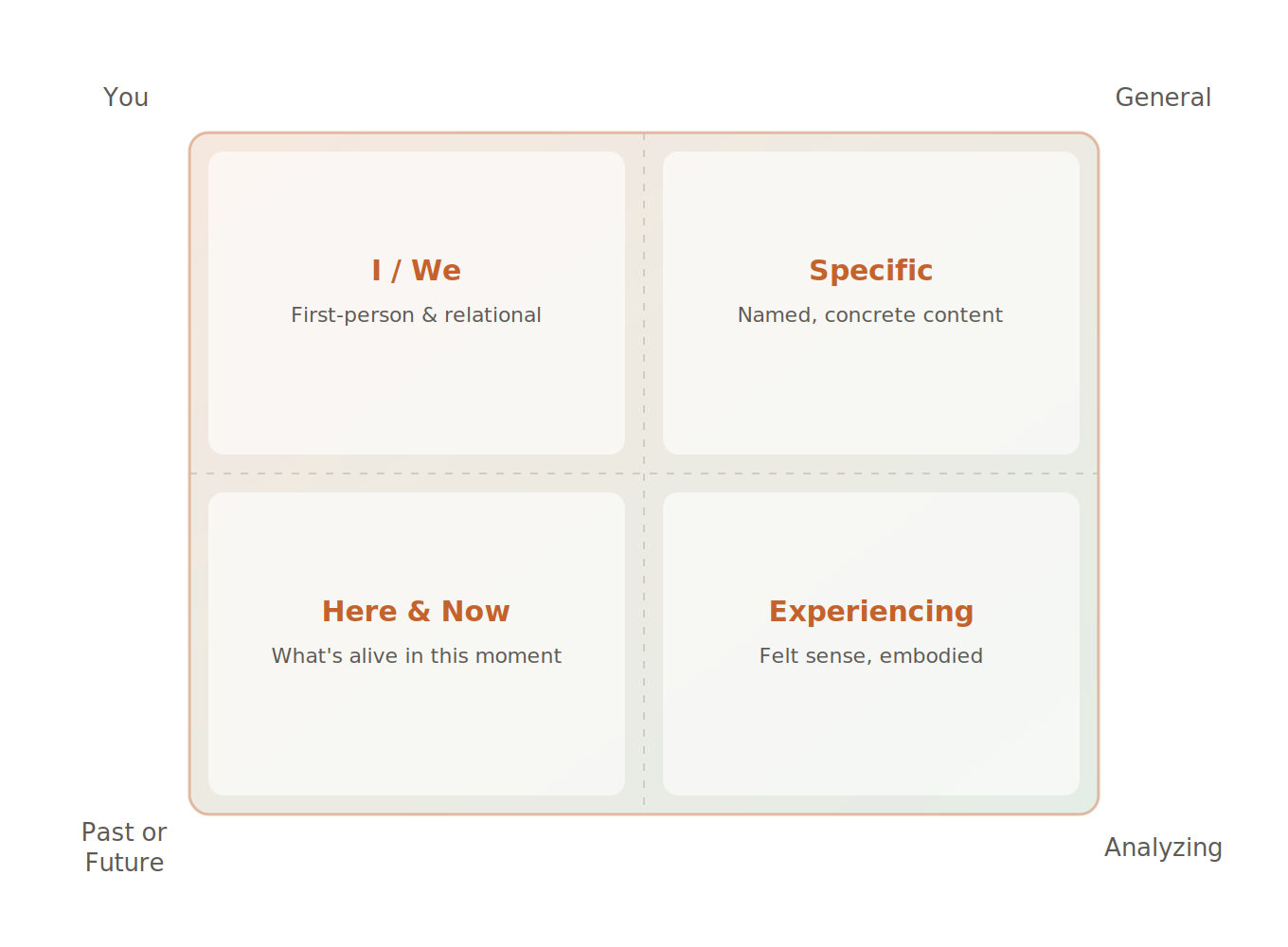
The objective is to practice giving others a more immediate experience of you as a leader. This is sometimes easier said than done. As social animals our survival has often depended upon our ability to adapt and protect ourselves not only physically but emotionally. This has led to some protective habits that are hardwired in - what Brené Brown calls “armouring up.”
The framework won't make that instinct disappear, but it gives you a way to work with it deliberately. This tool is most useful in helping you make moment to moment decisions about how you are communicating and the level of personal risk you are willing to take. Here are three examples of shifting from outside to inside:
You are in a performance review giving your directed report feedback about what they need to change in order to improve (outside.) A move to the inside would include letting them know that you believe in them (You to I) or asking them what it’s like to receive this feedback (analyzing to experiencing.)
In a recent meeting, one of your peers was critical of your recommendations. This happens even though you had met with your colleague prior to the meeting where they hadn't expressed any concerns about your plan. You are now following up with them. You move from outside (focusing on the past) to the inside (in the present) by naming the emotional field. “I notice this conversation is getting heated, which may not be useful for us in resolving this.”
You are in an all-hands meeting and get a tough question from an employee about a decision made by senior leadership. Instead of generalizing (“This is the way it goes.”) you share the reasons (specifics) behind the decision and include empathy (you to I) for their concerns.
Moving from outside to inside takes intention and practice, so it can help to work with an executive coach to explore where you feel most vulnerable in your interactions and what you may be protecting.
Here are some questions to ask yourself in preparing for your next important conversation:
What’s the most important thing I want the other person to know about me or this situation?
If I were to share something that is not as known to others about me, what would it be?
What’s one thing I am not willing to reveal?
What helps me be present in the moment?
What’s at risk for me if I stay connected to my emotions?
I have seen over and over again the power of this tool for increasing trust by bringing people closer to you. One last word, it’s not about transparent, specific and in the moment all the time. Each situation and relationship calls for different levels of disclosure and immediacy.
